the Hidden Bookcase .co.uk
find those books you have been looking for...
Yandex Behavioral Factors for Small Booksellers: How a Click Panel Works and What It Risks
A small online bookshop can have exactly the right book in stock and still sell nothing because nobody finds the page. A complete run of Sweet Valley paperbacks or a shelf of Sleepover Club titles only earns money when a reader searching for them lands on your listing. If your buyers are in Russia or nearby countries, the search engine that decides this is often Yandex, not Google, and Yandex ranks pages in its own way.
A big difference is how much weight Yandex is widely believed to give to behavioral factors, meaning how people act on the results page and on a site once they click through. A whole category of services now simulates that behaviour. This piece explains how one of them works, using a single panel as the example, and what a bookseller is taking on by using it.
The signal these services imitate
Behavioral factors (ПФ in Russian SEO slang) are signals collected from visitors. Someone types a phrase, picks your result from the list and stays on the page rather than returning to the results. A result that searchers keep choosing looks more relevant than one they skip.
The appeal for a niche shop is easy to see. A specialist page for out-of-print children's series may be more useful than a marketplace listing and still sit on page two because hardly anyone has visited it yet. Behavioral-factor services offer to create that visitor history: searches for your phrases in Yandex, then visits to your site from the results page.
Yandex treats artificial manipulation of behavioral signals as a breach of its rules, and sites caught doing it can be penalised. For a shop that took years to build, this is a real risk to weigh before you start, not a free boost.
Why book searches suit precise keywords
Booksellers start with one advantage. Book searches are specific. People type a series name, an author, a volume number, or add words like "buy used" or "full set". These long, exact phrases get less traffic than broad ones, but the people who type them already know what they want, so they are the ones worth working on.
Make the list from your own catalogue, not from guesses. One phrase per series, a few for the titles readers ask about most often, and variants with "set" or "lot" for bundles is a sensible start for a small shop.
Setting up a project in PF-MONSTR
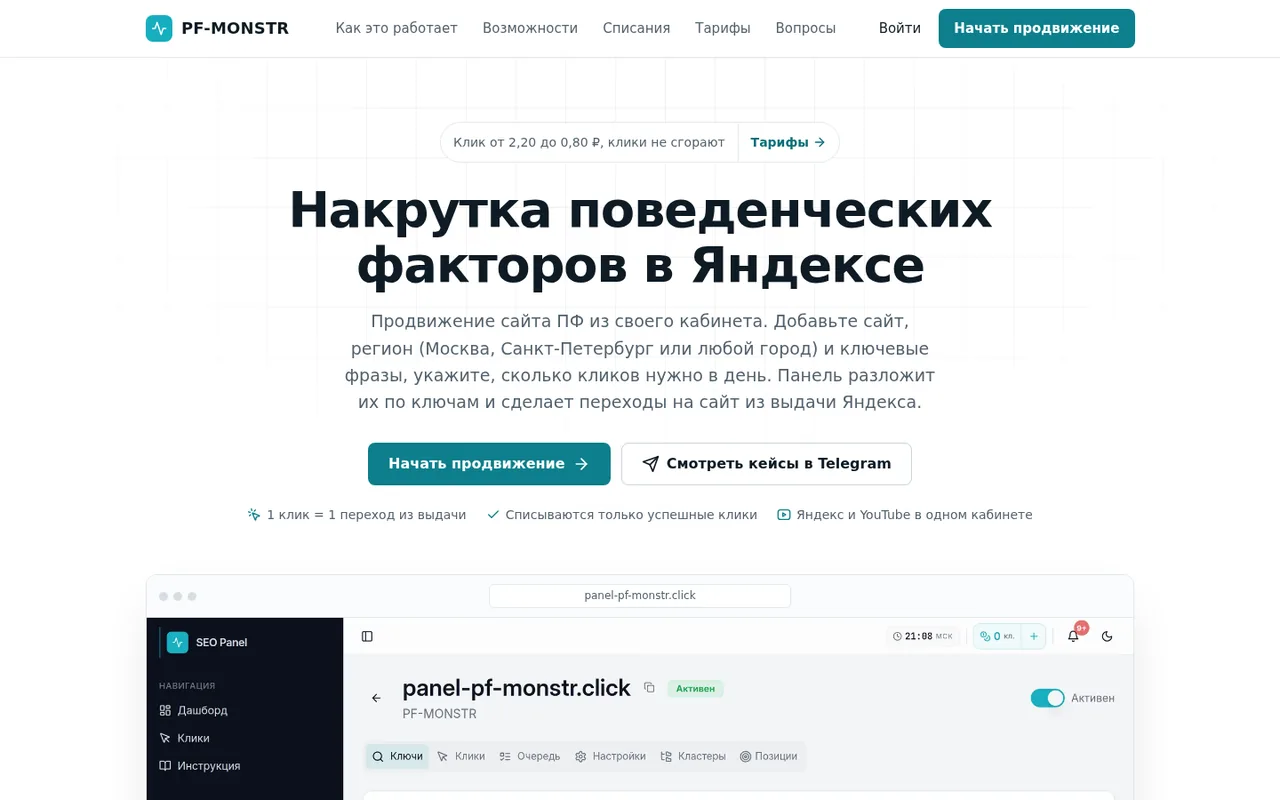
The example here is PF-MONSTR, a self-service panel for Yandex behavioral-factor promotion. Everything is set up inside the account, with no manager involved.
- Add the site. Enter the domain without the http:// prefix, give the project a name you will recognise, and pick a region. It can be Moscow, Saint Petersburg or any other city, and it covers every phrase in the project.
- Paste the phrases. One per line. Each can have its own target page and daily click count.
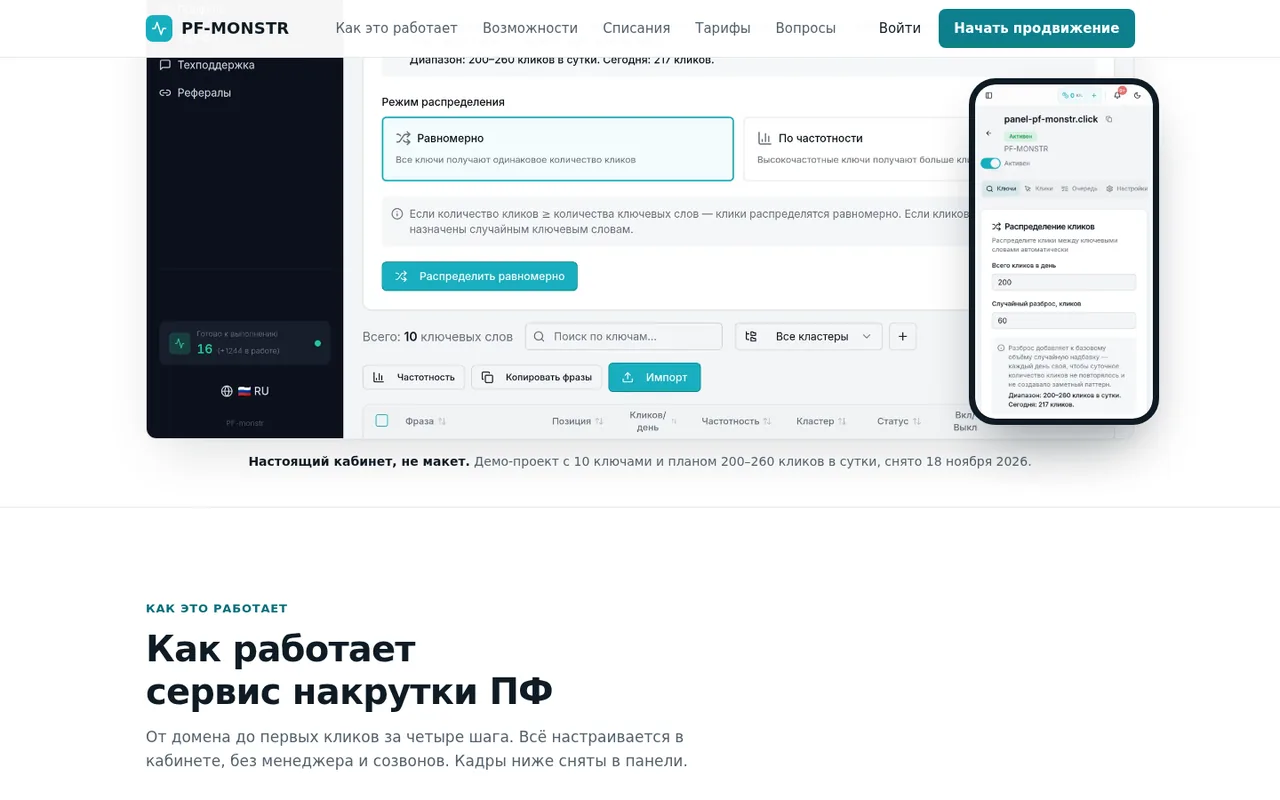
- Set the daily volume. Choose a total and a random spread so the number changes from day to day. Clicks can be split evenly or weighted by search frequency.
- Follow the results. The panel shows a task queue, a click history and position checks by date.
Choose the region carefully. If you ship from one city or most of your buyers live in one area, set the region to where they actually search. Clicks from somewhere your customers don't live tell you nothing useful.
The keyword table and clusters
Phrases are listed in a table with their position, daily clicks, frequency, cluster and status. You can select several rows and change clicks, target URL, cluster or auto-clicks for all of them at once. Each phrase also has a switch that pauses it without deleting it, which helps when a title sells out and you don't want to send visitors to an empty listing.
Search frequency can be checked from the same screen at 0.10 click per phrase. Checking a long list costs something, but not much.
Related phrases can be grouped into clusters by hand or automatically, and the automatic option shows a preview before anything changes. One cluster per series works well for a bookshop, because you can see which part of the stock is moving.
What you pay for
Beginners tend to overspend in the first week, so it helps to know how billing works. One click is one visit from the Yandex results page. You are charged only for successful clicks, where the visit to the site actually happened, and clicks you have bought do not expire.
| Item | Cost |
|---|---|
| One click (visit from search) | From 2.20 ₽, down to 0.80 ₽ at larger volumes |
| Position check | 0.15 click per query |
| Frequency check | 0.10 click per phrase |
| Trial bonus | 100 clicks for linking Telegram in your profile and subscribing to the channel |
The top-up screen shows the price and total as soon as you choose a number of clicks. A "clicks for the period" block estimates what you need for a week or a month from your projects' daily limits. You can pay by card or SBP, in cryptocurrency, or through CryptoBot in Telegram, and the payment history exports to CSV.
The demo project in the dashboard runs 10 phrases at 200–260 clicks a day. A small shop testing the idea can start far below that, with a handful of phrases and a few clicks each.
Scheduled auto-clicks
Auto-clicks add clicks to one or more phrases at set intervals: from 1 to 100 per run, at least five minutes apart. The panel shows straight away what that comes to per hour and per day. Check that figure. A sudden jump on a phrase that used to get a few visits a week is exactly the kind of pattern that looks unnatural.
Reading the results and knowing when to stop
You track positions to see whether anything changes, and to stop paying if nothing does. Checks are saved by date, so you can compare periods, open the history of a single phrase and export to Excel. If a cluster hasn't moved after a reasonable test, turning it off costs nothing.
A few other features matter once a project is running:
- Project settings hold the region and profile category. The domain is checked daily against the Roskomnadzor registry.
- Co-owners can edit a project, while clicks are paid from the owner's balance. This suits a shop where a partner looks after the website.
- PDF reports for any period, in a light or dark theme.
- Copies and groups: a copy keeps the settings and phrases, and sites can be sorted into searchable groups.
- Support chat in the account, with screenshots. An AI assistant answers first and an administrator takes over when needed.
- A built-in manual of 18 illustrated sections, from adding a first site to the API and reports.

Video, API and referrals
Some booksellers also run a YouTube channel with unboxings, collection tours or reading lists. The same account covers YouTube promotion, where you set view volume, pace and keyword phrases and pay for the tool's work. An API token made in the profile works for both Yandex clicks and YouTube, though that only matters if you already automate other parts of the business. A referral programme pays a 10% bonus on top-ups made by people who sign up through your link.
Where the effort pays off with no risk
Clicks can only help a page that is already worth visiting. A listing with a vague title, no condition notes and a copied description will lose the visitor whatever brought them there. Exact titles and volume numbers, honest notes on wear and missing pages, clear photos and descriptions written for readers help every visitor, cost nothing in penalties and keep working after you stop paying.
If you do try a behavioral-factor panel, keep the test small, point it at your strongest pages and set a date to judge the results. Then decide whether a gain in Yandex is worth putting a shop you have spent years building at risk.
